

Universitas Prasetiya Mulya

Social Impact

Nowadays, business education is no longer focused solely on profit generation. Social impact has increasingly become an important aspect, including among leading business schools worldwide. This is reflected in the accreditation standards established by the Association to Advance Collegiate Schools of Business (AACSB), which emphasize commitment to engagement, innovation, and meaningful impact on society. In response to these expectations, the School of Business and Economics (SBE) has explicitly integrated social impact values into its vision and mission.

During the 2020–2024 period, SBE adopted the mission “Educate entrepreneurial leaders to be able to navigate changes effectively and deliver constructive solutions for the advancement of business and societies.” Within this mission, the emphasis on “constructive solutions for the advancement of societies” demonstrates that social impact has been an integral part of SBE’s educational direction.

In response to changing global dynamics and emerging societal needs, SBE revised its mission in 2024 to “Educating business learners to have entrepreneurial competencies by providing innovative solutions for the advancement of business and society.” Although the wording changed from “entrepreneurial leaders” to “business learners with entrepreneurial competencies” and from “constructive solutions” to “innovative solutions,” the essence of integrating social impact remains unchanged. Society remains the ultimate beneficiary of every solution generated. Therefore, this mission update does not diminish the institution’s focus on social impact; rather, it serves as a strategic renewal to ensure that education remains adaptive, innovative, and relevant to future business and societal challenges.


Department Contact Info

Small Business Development Center

School of Business and Economics, Universitas Prasetiya Mulya
BSD Campus – 9th floor, PMBS Building
ppuk@prasetiyamulya.ac.id

Mon – Fri 8:00A.M. – 5:00P.M.


1.Community Development (COMDEV)

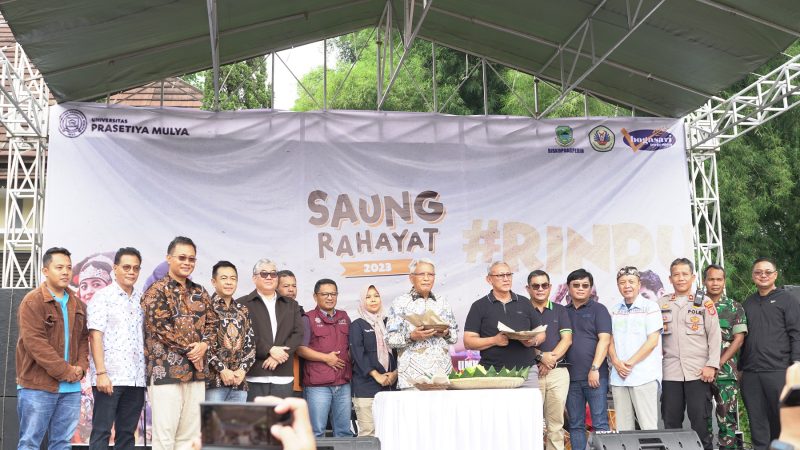
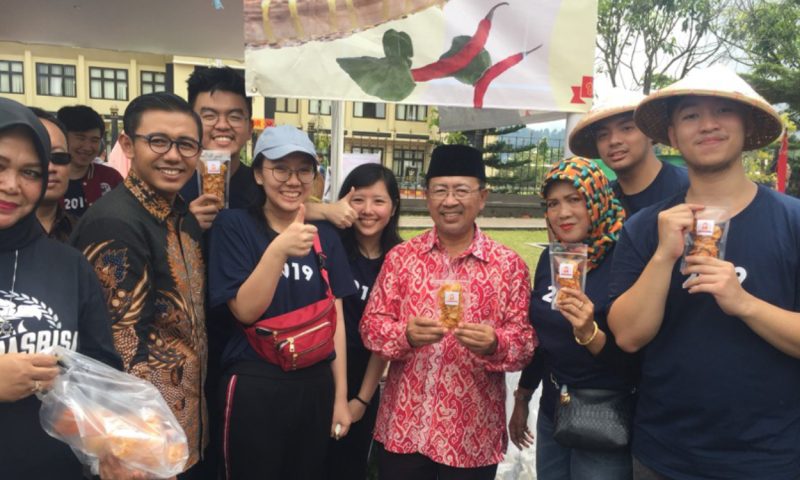
Saung Rahayat 2019: Showcasing MSME Excellence at Cipanas Palace

At SBE, social impact is embedded within academic activities involving students, faculty members, and staff. The flagship social impact initiative is the Community Development (COMDEV) Program, through which SBE participants engage in live-in experiences with rural small-business entrepreneurs to support the development of their business ventures.

From 2020 to 2025, COMDEV mobilized 6,864 students and established a total of 759 partnerships with micro-enterprises, 88 partnerships with villages, 34 partnerships with vocational high schools, 3 industry partnerships, and 4 community partnerships across West Java (Kuningan and Cianjur), Banten (Tangerang), and several other regions throughout Indonesia.

These businesses represent diverse sectors ranging from agricultural production to environmentally friendly handicrafts. The cross-sector and multi-stakeholder partnerships were intentionally designed to strengthen the entrepreneurial ecosystem at the local level. Approximately 40–60 faculty members participate in mentoring and technical support roles for each batch.
Together, they collaborate to foster local economic development through entrepreneurship. SBE also measures the success of the COMDEV program using various performance metrics as part of its continuous improvement efforts.

2. 2026 AACSB‘s Global Impact Awards kategori Societal Impact: Addressing Regional or Local Challenges

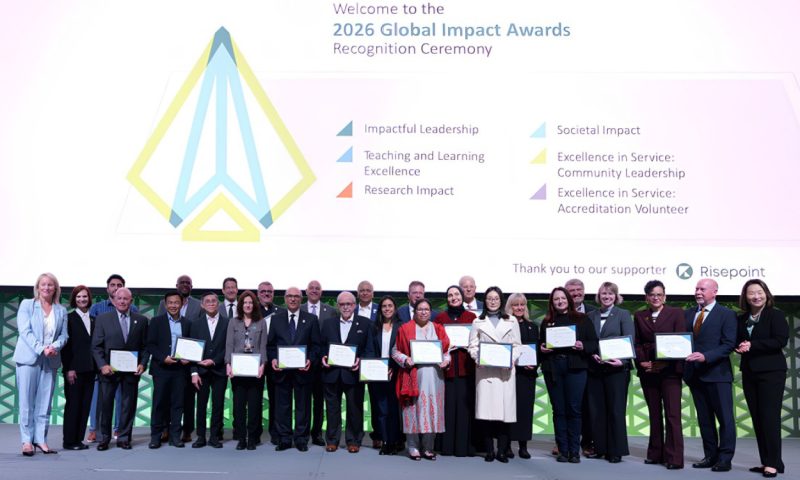
(Tuesday, April 14, 2026) Universitas Prasetiya Mulya officially received the 2026 Global Impact Awards in the category of Societal Impact: Addressing Regional or Local Challenges, organized by AACSB at the Seattle Convention Center – Summit Building, United States.)

On April 7, 2026, the COMDEV Program received the 2026 AACSB Global Impact Award in the category of Societal Impact: Addressing Regional or Local Challenges.

This award recognizes Universitas Prasetiya Mulya’s innovation, measurable impact, and sustained contribution to community development through business education. The recognition was earned through efforts to strengthen micro and small enterprises in rural communities using a collaborative Living Lab approach. This approach integrates student learning experiences with direct community empowerment initiatives, resulting not only in enhanced business capabilities within local communities but also in the promotion of sustainable economic growth.

In 2026, the award was presented to 27 individuals and institutions from 16 countries through a highly competitive selection process.

3. RASIO (Online Business Inspiration and Consultation Center) Program

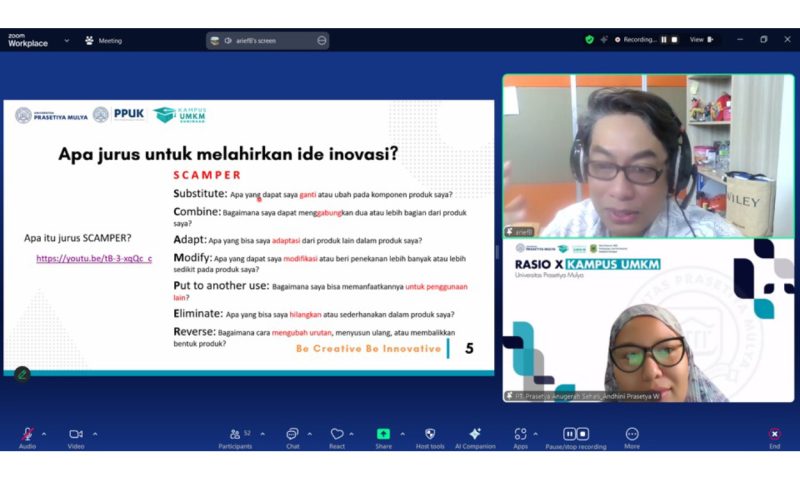
RASIO Program x MSME Campus - Kuningan 2025

In 2021, SBE initiated the RASIO (Online Business Inspiration and Consultation Center) Program as part of its commitment to societal contribution.

Philosophically, the Center for Small Business Development (PPUK) designed RASIO to take a different path from conventional community development programs. PPUK deliberately avoids mainstream approaches that often measure success solely by exposure or participant numbers. Instead, RASIO is built upon three core pillars: quality mentoring, measurable outcomes, and sustainable impact.

From 2021 to 2026, the evolution of RASIO has demonstrated that broad program reach can coexist with high-quality empowerment. Quantitatively, this collaborative ecosystem has evolved into a catalyst for empowerment, mobilizing thousands of student facilitators to support hundreds of MSMEs across various regions, 49 village partners, and capacity-building initiatives for 100 vocational high school principals throughout Indonesia.

Rather than focusing merely on exposure metrics, PPUK ensures that every figure represents meaningful transformation. This commitment to quality is reflected in an intensive mentoring methodology that has achieved participant assignment completion rates of up to 82.75% and satisfaction rates consistently exceeding 90%.

The program reached a major milestone during 2024–2025 through collaboration with the Kuningan Regency Government, culminating in the establishment of the “Prasmul Partner Community Forum.”

4. Wirausaha Merdeka Program

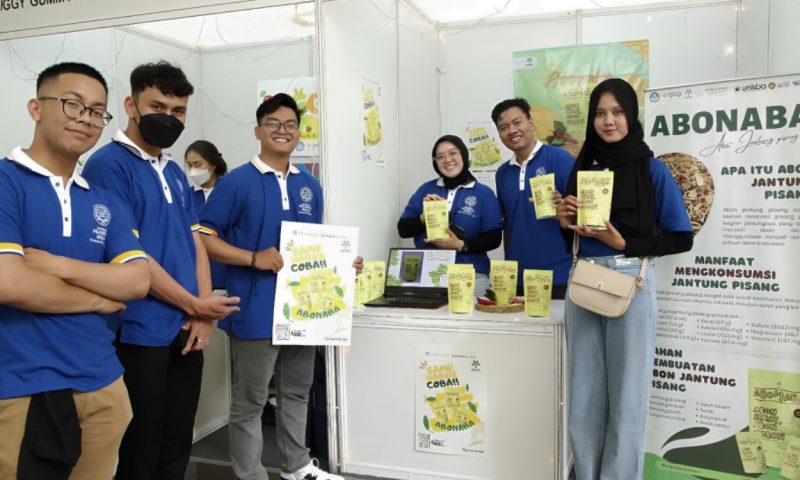
Abonaba, One of the Best Prototype Winners in the Wirausaha Merdeka Program at Universitas Prasetiya Mulya

SBE also contributes to society through collaboration with the national government. For example, SBE participated in the “Wirausaha Merdeka” (Emancipated Entrepreneur) Program initiated by the Ministry of Education, Culture, Research, and Technology under the Kampus Merdeka framework in 2021 and 2022. This initiative provides students with opportunities to learn and develop themselves as future entrepreneurs through activities conducted outside the classroom. As the host university, SBE welcomed 330 students from various universities across Indonesia.

In 2024, SBE also collaborated with the Ministry of Cooperatives and SMEs in implementing the Kampus UKM Semester 2 Program. The program was developed through a multi-stakeholder collaboration involving nine training institutions and two higher education institutions. The activities included five online training sessions attended by approximately 210 MSME participants and concluded with an offline workshop for selected MSMEs. The instructors consisted of a combination of SBE faculty members and accomplished entrepreneurs.

5. Participation in Think 20 (T20) Indonesia

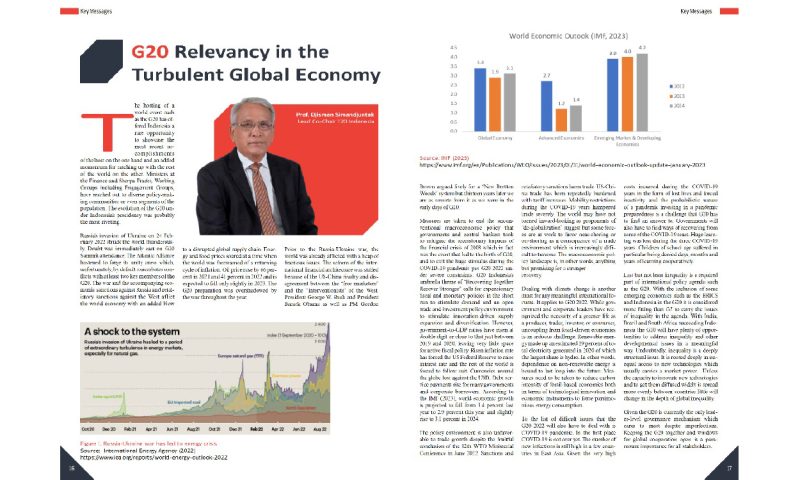
Source: https://www.t20indonesia.org/

One faculty member from the Bachelor of Economics Program at SBE served as Co-Chair of Think 20 (T20) Indonesia in 2022. T20 provides a platform for academics, policymakers, and stakeholders to address pressing global challenges, including sustainable development, environmental resilience, and climate change mitigation. The faculty member’s involvement included contributions to policy recommendations related to the Sustainable Development Goals (SDGs), particularly Climate Action (SDG 13), Life Below Water (SDG 14), and Sustainable Cities and Communities (SDG 11).

Furthermore, these policy recommendations emphasized the importance of environmental sustainability through renewable energy, reforestation, and biodiversity conservation while advocating for equitable climate financing for developing countries, a key theme of Indonesia’s G20 Presidency.

6. Sholarship Program

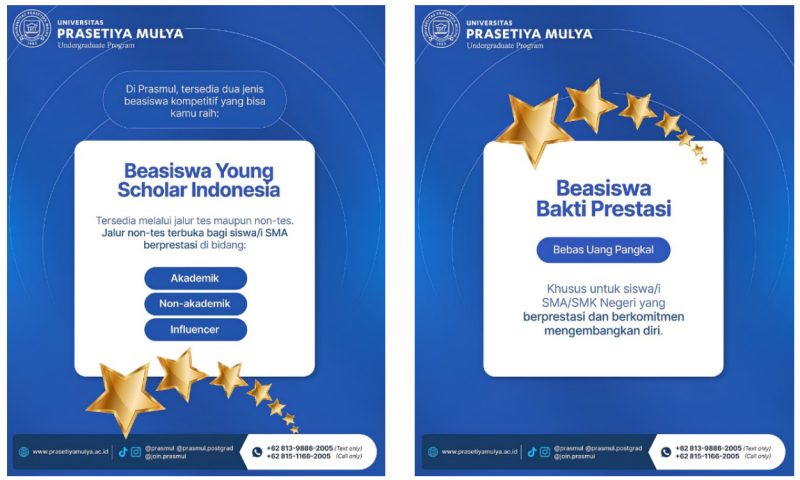
Two Types of Scholarships at Prasmul

The University’s scholarship initiatives continue to expand through two programs: Youth Scholar Indonesia (YSI) and the “Bakti” Scholarship. YSI is intended for high-achieving prospective students regardless of their financial background. Meanwhile, the Bakti Scholarship is designed for academically talented students from economically disadvantaged backgrounds.
In 2025, the number of scholarship recipients reached 7 students under the YSI program and 101 students under the Bakti Scholarship program.